
Coordinating international applied research and strengthening collaboration between countries
GABRIEL network
Created in 2008 by the Mérieux Foundation, the GABRIEL network (Global Approach to Biology Research, Infectious diseases, and Epidemics in Low-income countries) is an international scientific network operating in synergy to develop its research and training capacity and improve the surveillance of infectious diseases that have a significant impact on public health.
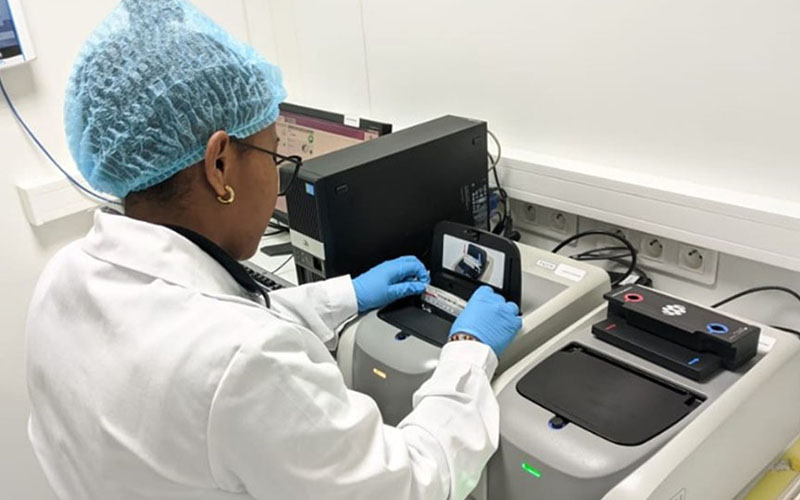
The GABRIEL network links 22 laboratories, including eight Rodolphe Mérieux Laboratories, in 16 countries: research units associated with universities, hospitals, or NGOs, which jointly conduct research programs on acute respiratory infections, tuberculosis, antimicrobial resistance, and emerging diseases.
By connecting scientists across four continents, the GABRIEL network supports the creation of a community of experts able to generate data and recommendations tailored to local realities and priorities wherever they are most needed.
Support for the GABRIEL network
The Foundation supports the structuring of the GABRIEL network to give laboratories the means to address research priorities collectively, generate high-quality data, gain visibility, and access funding opportunities.
Support for the development of intra-GABRIEL collaborative programs:
- In 2025, the project to create a Data Science Center to work on antimicrobial resistance in Madagascar and Burkina Faso resulted in the platform being transferred to the health authorities. This surveillance tool was developed by the Charles Mérieux Center for Infectious Disease in Antananarivo and the Souro Sanou university hospital in Bobo-Dioulasso. The Foundation coordinated the initiative alongside the Bill & Melinda Gates Foundation, which supported the project through the “Grand Challenges 2022” call for projects dedicated to public health interventions based on data.
- Two collaborative projects are in progress with the Christophe Mérieux Laboratory in Beijing (operated with the Pathogen Biology Institute of the Chinese Academy of Medical Sciences): a study of the epidemic characteristics of respiratory pathogens following the Covid-19 pandemic in Bangladesh and a project examining respiratory syncytial virus in Brazil.
Support with project submission to help laboratories respond to calls for projects from international funding bodies as a coordinator or consortium partner. In 2025, two tuberculosis projects were submitted to the funding bodies ANRS Emerging Infectious Diseases (MIE), an independent Inserm agency, and the Stop TB partnership.
Support for the adoption of a quality management system (based on the ISO 15189 and ISO 9001 standards) through the Mérieux Foundation’s Quality Initiative. Laboratories in Haiti, Mali, Cambodia, and Laos have been accredited. The application from the Madagascar laboratory was submitted to the accreditation agency in 2025.
GABRIEL network highlights in 2025
Facilitation of three international working groups:
- The leprosy working group, with a “journal club” format to discuss a scientific article and the potential for harnessing the methods used (countries represented: Bangladesh, Madagascar, Brazil, and Paraguay).
- The antimicrobial resistance workshop, which led to the creation in 2025 of a collaborative project on the evolution of AMR in association with climate change (six countries: Burkina Faso, Brazil, Bangladesh, Cameroon, Lebanon, and Mali).
- The viral hepatitis working group, initiated at the network’s last international meeting in 2024, covering diagnosis, clinical research, epidemiology, and prevalence surveys.
Data analysis support for the network:
- Training in next-generation sequencing and bioinformatics in partnership with FIND. Module available in French/English, with final assessment and certification (818 participants since the program was published online in September 2024).
- Training for a doctoral student at the Foundation’s headquarters as part of his research into leprosy (supervised jointly by the University of Antananarivo in Madagascar and the University of Leiden in the Netherlands).
- Support for the Charles Mérieux Center for Infectious Disease in Madagascar in data analysis and interpretation, and the drafting of an article on SARS-CoV-2 surveillance.
- Statistical analysis support for three projects in the Democratic Republic of the Congo.
Participation in several international events, including the Pasteur Network meeting on June 24 and 25 in Lille on wastewater monitoring, and the third edition of the “Sustainable Health For All” Forum held in Lyon from November 2 through 5, 2025.

The GABRIEL network in figures
- 11
research projects in progress (4 TB, 3 AMR, 3 ARI, 1 COVID) - 97
collaborative publications since 2012 - +2,500
scientists trained (through mentoring schemes, workshops, and online courses) - 11
online training modules on epidemiology, clinical research, molecular biology, arbovirus diagnosis, biobanks, and bioinformatics - 13
grants awarded to doctoral students in the GABRIEL network since 2018 - 14
young researchers’ prizes designed to support and encourage the careers of promising young researchers since 2014
Creation of a mapping of the network’s expertise
Resulting from a study carried out by the Mérieux Foundation between 2022 and 2023, the mapping of GABRIEL network expertise was published in 2025 in the scientific journal BMJ Global Health. This work characterized the activities, themes, collaborations, and national and international roles of each organization in the network. The mapping paves the way for new collaborative research projects for the benefit of global health, transcending geographical boundaries.
Support for research through joint supervision of theses by young researchers
In 2025, the GABRIEL network supported three doctoral students with their research projects: a thesis on leprosy by a student at the Charles Mérieux Center for Infectious Disease in Madagascar, and two theses by students at Nazi Boni University in Burkina Faso on the TRICYCLE/TRIUMPH program (AMR surveillance) and the dynamics of tuberculosis transmission in at-risk populations.